
Creating Green Boutique Buildings
Create a healthy living environment decoration
BLOG
The entry point for the marketization of green buildings lies in cost-effectiveness.
2019-12-18
In recent years, with the continuous improvement of sustainable development strategies and the rapid growth of the construction industry, the impact of the construction industry on society and the environment has deepened. China's green building sector has emerged as a formidable new force, increasingly becoming an undeniable new power. In the era of ecological economy, green building is flourishing; however, many issues such as marketization, technological level, industrialization, and informatization remain to be resolved. How can green building advance further and more deeply?
At the end of March, the 10th International Green Building and Building Energy Efficiency Conference gathered many industry veterans in Beijing to vigorously debate the trends in green building. This report selectively presents some highlights for readers.
In recent years, with the continuous improvement of sustainable development strategies and the rapid development of the construction industry, the impact of the construction industry on society and the environment has deepened. China's green buildings have emerged as a new force that cannot be ignored. In the era of ecological economy, green buildings are flourishing. However, many issues such as marketization, technological level, industrialization, and informatization remain to be solved. How can green buildings go further and deeper?
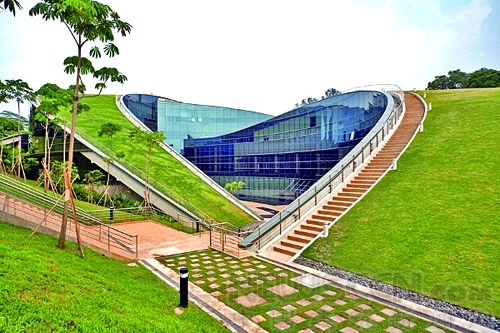
The "National New-type Urbanization Plan (2014-2020)" clearly proposes to significantly increase the proportion of green buildings in the coming years. How can ordinary people recognize green buildings? What is the entry point for China's green buildings to truly enter the homes of ordinary people? At the 10th Green Building Conference's forum on the market-oriented development of China's green building real estate, participants engaged in lively exchanges and discussions.
Government promotion alone is not enough
"This year marks the tenth anniversary of our green building journey. Looking back at the past ten years, we can see that the government has played a huge role in the development of green buildings," said Yang Rong, Director of the Department of Building Energy Efficiency and Technology at the Ministry of Housing and Urban-Rural Development. The Third Plenary Session of the 18th Central Committee clearly stated that the market should play a decisive role while the government should play an important role. Under this guideline, truly mobilizing the vitality and enthusiasm of the market is an important topic we need to further explore.
Data shows that by the end of 2013, a total of 1,260 green building evaluation label projects were selected nationwide, including 480 one-star green building projects, 530 two-star green building projects, and 312 three-star green building projects.
However, very few ordinary people truly understand green buildings.
Zhang Xuezhou, Vice President of the National Federation of Industry and Commerce Real Estate Chamber of Commerce, conducted a survey at the forum. Among more than 100 participants, only 3 clearly knew they were using green buildings. "This shows that the market coverage of green buildings is very small. For the vast majority of people, green buildings sound good but they have not yet come into contact with such houses."
Two key points of marketization
Green buildings are by no means an elite concept, nor should they be inaccessible. By 2020, the proportion of national green building development is expected to reach 50%, but currently the coverage rate of green building area is still very low. Xu Wei, Director of the Environmental Energy Institute of the China Academy of Building Research, said: "Even excluding rural buildings, the building area in our country is 20 billion square meters."
Obviously, getting ordinary people to accept green buildings depends on market leverage. Yang Rong pointed out that value and demand are the two major factors at play in the market.
Although the value of green buildings has gradually gained broad consensus in production, academia, research, application, and government sectors over the past ten years, the value of green buildings has not yet penetrated all aspects of society or deeply into the hearts of ordinary people. "Is the value of green buildings only the 'four savings and one environmental protection' proposed in the past lifecycle? Are there many other aspects related to the relationship between humans and the natural environment and human health development? These all require us to further explore its value," said Yang Rong.
Where does demand come from? It comes from the public's recognition of the intrinsic value of green buildings. Yang Rong pointed out: "Green buildings should better fit the actual development of our country, better meet market demand, and better meet the quality requirements of the broad masses of people for buildings."
High cost-performance ratio is the key to being grounded
"Ordinary consumers pursue one thing — cost performance, the purchasing power and the quality of the house they get," emphasized Xu Wei. The prerequisite for consumers to accept green buildings lies in the cost performance of the house.
In fact, existing green buildings are not all out of reach. The Jinmao Mansion project by Fangxing Real Estate in Beijing received unanimous praise from participants. According to the introduction, the project adopts twelve green technology systems, achieving a combination of low energy consumption and high comfort. "As a consumer, I understand green buildings as energy-saving and environmentally friendly, with good air cleanliness, temperature, noise control, and property landscaping. I think everyone has this demand," said Chang Haijun, an owner of the project. After inspecting more than 30 projects in Beijing, he finally chose Jinmao Mansion. In the interactive session, he introduced that a friend of his effectively improved sleep quality in the constant temperature and oxygen environment of Jinmao Mansion.
"What is the dividend of green building development? It is the improvement of environmental quality and the reduction of energy consumption," said Lin Borong, professor and doctoral supervisor at the School of Architecture, Tsinghua University.
Enjoying the dividends of green building development does not mean consumers have to pay more. "If you want to buy green buildings, you must not only calculate the current price. Considering the advantages of annual property fees, heating fees, air conditioning fees, and improved quality of life after using green buildings, green buildings are more economical," said Zhang Xuezhou. The construction or purchase cost of green buildings may be higher than ordinary buildings, but the long-term operating cost is definitely lower.
"Consumers should not only consider the construction cost of green buildings but also calculate the savings over 50 years or longer of using green buildings. The slogan of the Jinmao Mansion project is affordable cost, which combines ground source heat pumps with constant humidity, constant temperature, and independent control, reducing customers' usage costs," said Sun Guodong, Design Director of Fangxing Real Estate (China) Co., Ltd.
