Creating Green Boutique Buildings
Create a healthy living environment decoration
BLOG
The Provincial Department of Housing and Urban-Rural Development held a construction industry symposium for the southern Jiangsu area in our city.
2019-12-18
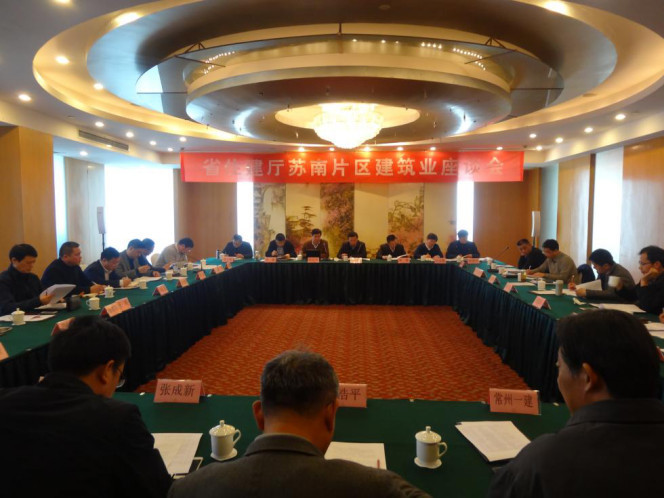
To implement the "Opinions of the General Office of the State Council on Promoting the Sustainable and Healthy Development of the Construction Industry," promote the reform and development of the construction industry across the province, and effectively complete the drafting of the "Implementation Opinions on Promoting the Sustainable and Healthy Development of the Construction Industry (Provincial Government Draft)," on March 14, the Provincial Department of Housing and Urban-Rural Development held a construction industry symposium for the southern Jiangsu area in our city to solicit opinions from all parties. Secretary Gu Xiaoping of the Provincial Department of Housing and Urban-Rural Development, along with heads of relevant offices, attended the meeting. More than 30 participants, including leaders in charge from the construction bureaus of Nanjing, Suzhou, Wuxi, Changzhou, Zhenjiang, Liyang, Yixing, and Kunshan, as well as some enterprise leaders, took part in the meeting.
To implement the "Opinions of the General Office of the State Council on Promoting the Sustainable and Healthy Development of the Construction Industry," promote reform and development of the construction industry across the province, and effectively complete the drafting of the "Implementation Opinions on Promoting the Sustainable and Healthy Development of the Construction Industry (Provincial Government Draft)," on March 14, the Provincial Department of Housing and Urban-Rural Development held a construction industry symposium for the southern Jiangsu area in our city to solicit opinions from all parties. Secretary Gu Xiaoping of the Provincial Department of Housing and Urban-Rural Development led relevant department heads to attend the meeting, with more than 30 participants including leaders in charge from the construction bureaus of Nanjing, Suzhou, Wuxi, Changzhou, Zhenjiang, Liyang, Yixing, and Kunshan, as well as some enterprise leaders.
The meeting focused on seven aspects: the overall requirements for promoting the sustainable and healthy development of the province's construction industry, advancing industrial transformation and upgrading, comprehensively enhancing engineering construction capabilities, improving engineering quality and safety levels, supporting enterprises to "go global," strengthening talent and team building, and optimizing the construction market environment. There was thorough exchange and discussion, especially on how government departments should increase support for enterprises to implement policies, encourage enterprises to grow stronger, enable private enterprises to participate in PPP projects and key infrastructure projects such as rail transit, regulate the behavior of construction units to fulfill primary responsibilities, and talent cultivation. Many rational suggestions were proposed.
The meeting focused on seven aspects: the overall requirements for promoting the sustainable and healthy development of the province's construction industry, advancing industrial transformation and upgrading, comprehensively enhancing engineering construction capabilities, improving engineering quality and safety levels, supporting enterprises to "go global," strengthening talent and team building, and optimizing the construction market environment. There was thorough exchange and discussion, especially on how government departments should increase support for enterprises to implement policies, encourage enterprises to grow stronger, enable private enterprises to participate in PPP projects and key infrastructure projects such as rail transit, regulate the behavior of construction units to fulfill primary responsibilities, and talent cultivation. Many rational suggestions were proposed.
Finally, Secretary Gu Xiaoping of the Provincial Department of Housing and Urban-Rural Development gave a concluding speech. He stated that the representatives were well-prepared, actively spoke, and provided deep insights. The solicitation of opinions was very fruitful. The provincial department will carefully study and absorb the rational suggestions, further improve the draft of the "Implementation Opinions," and do a good job in top-level design. He pointed out that the development of Jiangsu's construction industry should follow a path of connotative development, be based on actual conditions, reflect Jiangsu's characteristics, and emphasize problem orientation to better serve the development of private enterprises. At the same time, he required cities in southern Jiangsu to strive to be pioneers in deepening construction industry reform, take the lead in reform, boldly pilot, and create typical cases for the whole province to learn from.
Next, our city will promote the sustainable and healthy development of the construction industry from the following key aspects: First, implement the "integration of design and construction, integration of project management, and integration of government supervision" model to solidify the foundation with these three integrations and standardize management; Second, deepen reforms of the administrative approval system and bidding system, implement project guarantee and insurance systems, improve the project pricing system, and further optimize the construction market environment; Third, study regulatory methods for PPP and EPC model projects to serve enterprises and the overall economic development; Fourth, support enterprises to grow stronger and larger, encourage local construction enterprises to participate in key infrastructure construction such as rail transit projects, and guide enterprises to accelerate their "going global" pace; Fifth, vigorously develop prefabricated buildings and suggest implementing relevant preferential policies in finance and taxation; Sixth, comprehensively improve green construction capabilities, vigorously promote green building materials, and first pilot the promotion of green concrete in government projects; Seventh, increase efforts in technological innovation, continuously improve digital construction and information management capabilities, accelerate the application of BIM technology in planning, design, construction, and operation and maintenance processes, and fully implement information management systems such as tower crane early warning and entrance and exit video monitoring; Eighth, fully implement the responsibilities of all parties, continuously promote standardized management of construction sites, effectively strengthen quality and safety supervision capabilities, and promote further improvement of engineering quality, safety, and civilized construction levels; Ninth, optimize and improve the integrity assessment system for construction enterprises, "support the excellent and expand the strong" enterprises, while adhering to inventory reduction, filling gaps, eliminating backward enterprises, and improving general contracting management capabilities; Tenth, cultivate outstanding talents and enterprises to enhance the core competitiveness of our city's construction industry.
Support excellent enterprises, eliminate backward enterprises, and promote the strong and excellent.
The "Implementation Opinions on Promoting the Sustainable and Healthy Development of the Construction Industry" (hereinafter referred to as the Opinions) is a guiding document formulated to fully implement the "Opinions of the General Office of the State Council on Promoting the Sustainable and Healthy Development of the Construction Industry," practice the development concepts of innovation, coordination, green, openness, and sharing, deepen the supply-side structural reform of the construction industry, and has lasting and profound significance for the development of the construction industry in our province. The Opinions propose specific measures such as intensifying the reform of "delegation, regulation, and service," building the "Jiangsu Construction" brand, and supporting enterprises to "go global." It also points out seven major development directions for the province's construction industry and the development goal of fully building a higher-level strong construction province by the end of 2020.
At the symposium, the representatives fully exchanged and discussed based on their work realities and in reference to the content of the Opinions. In particular, they conducted in-depth discussions on how government departments should increase support for enterprises to implement policies, encourage enterprises to grow stronger, and how to enable private enterprises to participate in PPP project construction.
At the same time, the representatives also mentioned issues such as irregular behavior of construction units, the long audit period for construction projects, and the need to change various guarantee payment methods. They hope the Provincial Department of Housing and Urban-Rural Development will carefully study and fully consider solutions.